
Not so long ago, I was asked a question by a business in its second year of trading. It wanted to increase profitability, but like many young businesses, it was trying to work out how without breaking the bank.
The question was simple: How do we increase what customers are willing to pay for our products or services?
It got me thinking about the relationship between pricing, positioning and value creation.
After all, increasing prices is easy. Convincing customers that something is worth more is an entirely different challenge.
What makes something worth paying more for?
Pricing doesn’t exist in isolation. It works alongside a business’s position in the market, its brand, its competitors and the balance between supply and demand.
Take handbags.
A handbag from Primark might cost £15, while a Hermès Birkin can sell for tens of thousands of pounds. Both serve the same basic purpose, yet customers place very different values on them.
Of course, there are differences in materials, craftsmanship and availability. But these alone don’t explain the enormous gap in price.
A Birkin carries something beyond its practical use: exclusivity, identity, status and a story.
This is where brand equity becomes incredibly powerful.
A strong brand influences how customers perceive value long before they reach the checkout. It builds expectations, attracts particular buyers and establishes what people believe a product or service is worth.
We see this everywhere, from clothing and cars to coffee and professional services.
But there’s an important distinction. The price a business charges isn’t necessarily what every customer is willing to pay. Some customers would happily pay more, while others wouldn’t buy at half the price.
Willingness to pay (WTP) is personal. It represents the maximum amount someone would be prepared to exchange for the value they expect to receive.
Which brings me back to the original question with a little addition…
How can a business create more value for its customers without increasing its costs disproportionately?
The answer:
Value creation: more than adding something extra
My answer is value creation.
That might sound obvious, but I think it’s an area where businesses can easily confuse doing more with being worth more.
Value can come from improving an experience, removing frustration, offering additional benefits or strengthening the emotional connection someone has with a brand.
Sometimes the smallest changes have the greatest impact.
What interests me is the relationship between the value a customer perceives and the cost of creating it.
For example (and jokingly), handing out free biscuits to someone buying a mortgage probably won’t change their willingness to pay.
Unless, of course, the mortgage company is called Dunk and its entire proposition is built around having a cup of tea and making mortgages feel less intimidating.
Suddenly, the biscuits mean something.
The difference isn’t the biscuit. It’s the role it plays in the experience and the brand.
And that got me thinking about a framework.
The Willingness to Pay vs Cost Matrix
I’ve developed a simple matrix to explore the relationship between two things:
- How much a change increases customers’ willingness to pay.
- How much it costs the business to create and sustain that change.
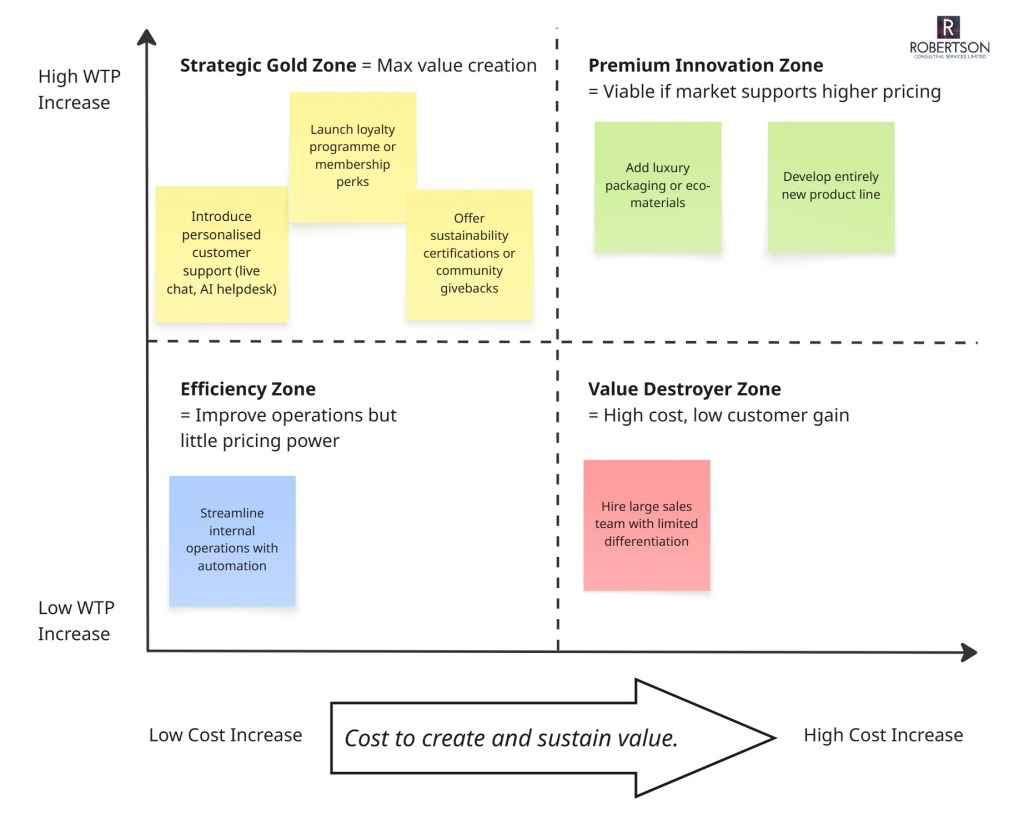
Diagram: WTP vs Company Cost to Create and Sustain Value by Christopher Robertson.
The result is four areas that represent very different commercial opportunities.
1. The Efficiency Zone: Low WTP increase, low cost increase
This is an interesting area because not every improvement in a business increases what customers are prepared to pay.
Automation, better internal processes and more effective teams can reduce operating costs and improve profitability without necessarily changing customer perceptions of value.
But there can be an indirect benefit.
I’ve seen businesses become more operationally effective and, as a result, deliver better customer experiences. Greater consistency, fewer mistakes and faster responses can all contribute to customer satisfaction and loyalty.
That doesn’t automatically mean customers will pay more. It might mean they stay longer, buy more frequently, or recommend the business to others.
And those outcomes have commercial value of their own.
2. The Value Destroyer Zone: Low WTP increase, high cost increase
This is the quadrant that comes with a warning.
Back when I ran my previous business, I employed an external sales team to generate leads and secure meetings.
We spent five figures.
The result? One meeting.
It was an expensive lesson in the difference between investing in growth and actually creating value.
Strictly speaking, that investment wasn’t designed to increase willingness to pay. It was designed to acquire customers. But it illustrates a wider problem: businesses can spend considerable amounts of money without generating a corresponding commercial return.
The same can happen when businesses expand teams, add features or invest in services that customers barely notice or value.
More investment doesn’t automatically create more value.
Sometimes it simply creates more cost.
3. The Strategic Gold Zone: High WTP increase, low cost increase
This is the quadrant that has the highest potential for impact.
It’s where relatively modest changes can have a meaningful effect on the value customers perceive.
A few possibilities come to mind: personalised customer support, membership benefits, accreditation, or even making an existing service easier and more enjoyable to use.
In my previous business, one of our best decisions was to make our training courses accredited.
The course content remained largely the same, but the accreditation provided certification and greater credibility, particularly when selling into professional environments.
We also introduced complementary one-to-one support for people taking the courses.
Interestingly, only around 20% of attendees took up that support. Yet its availability added to the perceived value of the overall offer and supported higher pricing.
There was a cost to providing both benefits, but it was relatively modest compared with the commercial opportunity they created.
For me, this is what makes value creation so interesting.
The customer doesn’t necessarily value something according to how much it costs a business to provide it.
And that difference can create a significant competitive advantage.
4. The Premium Innovation Zone: High WTP increase, high cost increase
The final quadrant is about making bigger investments to create a different level of customer value.
Luxury packaging, premium materials, entirely new product lines or a more exclusive customer experience can all sit here.
These changes may significantly increase willingness to pay, but they also bring greater costs, risks, and potential complexity.
There’s also the question of positioning.
A business moving into a premium market may find itself competing against completely different brands, serving customers with different expectations and potentially changing the relationship it has with its existing audience.
For some of the world’s most successful businesses this opportunity has created enormous value through premium positioning.
But a higher selling price doesn’t automatically translate into higher profitability.
The cost of delivering that premium experience, the number of customers willing to buy it and the effect on existing business all influence the outcome.
Conclusion
Value creation isn’t about charging more.
A business can create more value for its customers.
It can capture more of that value through higher prices.
Or it can become more profitable by delivering the same value at a lower cost.
These aren’t the same thing.
A better customer experience might increase loyalty without changing willingness to pay. A stronger brand might support premium pricing without substantially changing the product. And a more efficient operation might improve profitability without customers noticing any difference at all.
The WTP vs Cost Matrix helps see these opportunities separately.
It also raises another question: what makes value difficult for competitors to copy?
Accreditation, personal relationships, trust and a strong brand can create advantages that go beyond the immediate product or service. But not all advantages last, and even the best innovations can eventually become what customers simply expect.
A final thought
When I was first asked how a business could increase profitability, pricing seemed like the obvious place to start.
But the more interesting conversation was about value.
What are customers actually paying for? What makes one business worth more than another? And how much of the value being created can the business realistically retain?
I think there’s a fascinating distinction between a business that does more for its customers and one that creates something customers genuinely value more – for that we need to listen to the customers and review the market.
Perhaps the greatest opportunity isn’t in finding ways to charge more, but in understanding what makes something worth more in the first place.


Leave a Reply