
Why improving what you already have may be the fastest route to better team performance…
When a team isn’t performing, our instinct is usually to add something.
More training. A new manager. Better incentives. New technology. Another process.
Sometimes that’s exactly what’s needed.
But after years of building, training, and working with teams, I’ve come to believe we often ask the wrong question.
Instead of asking “What should we add?”, perhaps we should first ask:
“How do we get more from what we already have?”
That distinction matters because one route adds cost and complexity, the other starts by unlocking potential that’s already there.
The Add vs Improve Matrix
The two choices to improve performance can be therefore put into two camps: add something or make it better. This can be mapped on the following matrix:
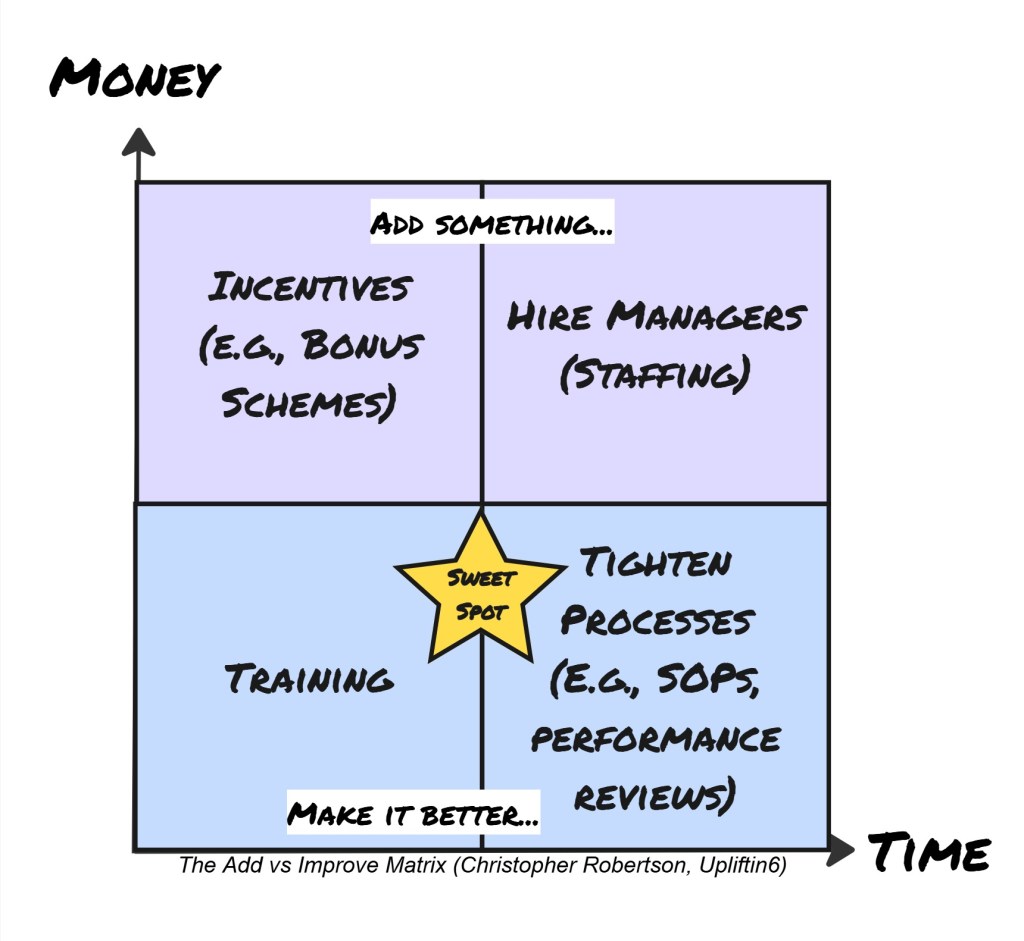
Add something…
It is a common rule in life that when people are discontent, we look outside ourselves (outside-in) to feel better. This is the point of consumer culture; we look to add something. Think about it, from buying the new house to having a drink after work, we look to add rather than turn inward. This usually comes with a price.
Incentives – There is evidence that incentives can work, particularly when combined with employee involvement, information sharing, and good workplace practices. There is also evidence of incentive gaming and situations where strong incentives shift effort towards measurable activities at the expense of harder-to-measure activities such as collaboration or long-term investment.
Hire a manager – Adding staff costs time and money. Typically, after the recruitment process there is a probation period of 3-months, and over that time there is a period of learning and training which require added investment. New software licences and even hardware are provided, not to mention time taken for teams to ‘welcome’ the new hire. This all costs the organisation and business owner with no guarantees. But furthermore, the hidden cost is in the team relationships. When a new person joins an organisation, they change the energy of the group. This is common law in groups dynamics.
A note on AI…
AI provides a fascinating example of the difference between individual capability and organisational performance.
Gallup’s State of the Global Workplace 2026 reports that 65% of US workers in organisations implementing AI believe it has improved their individual productivity. Yet an international survey cited by Gallup found 89% of executives reported no impact on company labour productivity over the previous three years.
People have the tool. The organisation isn’t necessarily getting the benefit.
And here’s the really interesting part: Gallup found that manager-led adoption and integration into existing systems were the two strongest drivers of frequent AI use.
Perhaps the problem isn’t always that businesses need more technology.
They need to get better at embedding what they already have.
Make it better…
When I ran my training company, we used the term ‘wellbeing is self-expression from the inside-out, not the outside-in’. Think about a work-out, talking and art therapies, singing, you name it – it comes from the inside out. To build a high-performing team, it stands to reason that this too must be built from the inside-out, and so it starts with the people and systems you already have in place.
Tightening Processes – this involves everything from SOPs to performance plans… iterative development at its finest. It takes time to build and then requires on-going reviews and amendments. Efficiencies are built and software can be put to great use… but it is only as good as the people involved, and so culturally, it needs to be embedded. My favourite saying, “we want commitment over compliance”.
Training – “People default to their level of training” (providing they have been well trained). Training needs to be applied to the context it is intended for… sounds obvious, but what this really means that it needs wash-through. There is a three-step process I use:
STEP 1: Learn – understand the skill or process usually by teaching.
STEP2: Train – practise it repeatedly in the context where it will actually be used.
STEP 3: Coach – step back, ask questions and help people solve the gaps themselves.
People learn a process/skill then they need to practice it. This takes time, but with immediate practice, can be embedded within a few weeks. The third phase is to stand back and coach; ask questions so that people fill in the gaps themselves. This is where the embedding is strongest.
The Sweet Spot
There is a sweet spot. Having founded and scaled a training company that extensively tracked outcomes, I can say without question – one-off training that is delivered without people immediately practicing techniques and even passing them on to others, is a ‘nice event’ at best.
Training that is driven into implementation, supported by data and diagnostic tools, creates an immediate effect and is the pathway to producing high-performing teams that have a positive cultural and commercial impact. Practices then need to be reviewed after a couple of weeks of implementation and then again further down the line to ensure they are sharpened and remove any blocks to adoption. Furthermore, training needs to consider not just the individuals but the team as a whole – where every member adds value and is valued.
Every person has potential that can be channelled to bring the most out of a team. If they have been hired with the right values, energy, and ability to learn, they can be part of a high-performing team. High-performing teams aren’t simply assembled from better components. They emerge when the people, relationships, skills and systems already inside an organisation reinforce one another.
That’s much of the thinking behind Upliftin6. I developed a service to help organisations identify what’s getting in the way of performance and turn that insight into practical change – an uplift for individuals, teams, and businesses. The formula is:
Energy + Skills = Impact. We use diagnostics to measure each part to turn the dial on performance.
If this challenge feels familiar, you can explore the approach at Upliftin6 here.
References
Gallup (2026), State of the Global Workplace 2026. Used for the evidence on the gap between individual AI productivity and organisation-wide productivity gains.
Blasi, J.R., Freeman, R.B., Mackin, C. & Kruse, D.L. (2008), Creating a Bigger Pie? The Effects of Employee Ownership, Profit Sharing, and Stock Options on Workplace Performance, National Bureau of Economic Research, Working Paper 14230. The research found that shared compensation had its strongest effects when combined with practices including employee involvement, training and lower levels of supervision.
Dube, A. & Freeman, R.B. (2008), Complementarity of Shared Compensation and Decision-Making Systems: Evidence from the American Labor Market, National Bureau of Economic Research, Working Paper 14272. The study found stronger outcomes when shared compensation was combined with employee involvement rather than used independently.


Leave a comment