Business owners must make many decisions daily, but there are four that set them up for success.
These four decisions, focus their energy, communicate who they are, differentiate themselves from their competitors, and identify where to invest their resources.
These decisions form the cornerstone of a business’s proposition and dramatically affect its performance when they go to market.
However, many entrepreneurs operate on gut feeling and instinct. While these decisions would have been certainly considered, they may not have been completely thought through and strategically implemented.
The typical entrepreneur will back a great idea and move into action. Strategy & documentation of their planning don’t feature very highly on the ‘to-do’ list. If anything, it’s added paperwork that only gets in the way.
But, if you feel like you have really thought through your plans, ask yourself, “how much have you documented before implementing them?”
So, what are these decisions? What do you do with that information? And what do you need to document?
The four decisions are:
- What product are you bringing to market?
- What service are you providing?
- What price-point are you selling at?
- What market are you selling into?
This seems like common sense.
However, these decisions are often considered separately and not in conjunction with each other. When this happens, decisions can work against each other rather than have the effect of compound interest. Specifically, product works against service and price is antagonistic to market.
Consider a Ferrari. We know that they are expensive to the average consumer, but the average consumer is not their market. Therefore, they don’t need to comment on price; their market is the wealthy. Instead, the way to position themselves would be on the quality of the product or the service that is provided with it. The car is fast not necessarily the most comfortable and so market & product is what they choose to focus on. This makes their route to market simple and more effective than trying to appeal to the masses.
A useful exercise is to position you and your competitors across this matrix. It will help you stand out and find where you should focus your marketing activities. Below, is a diagram of how this is done for beer with an explanation of each quadrant:
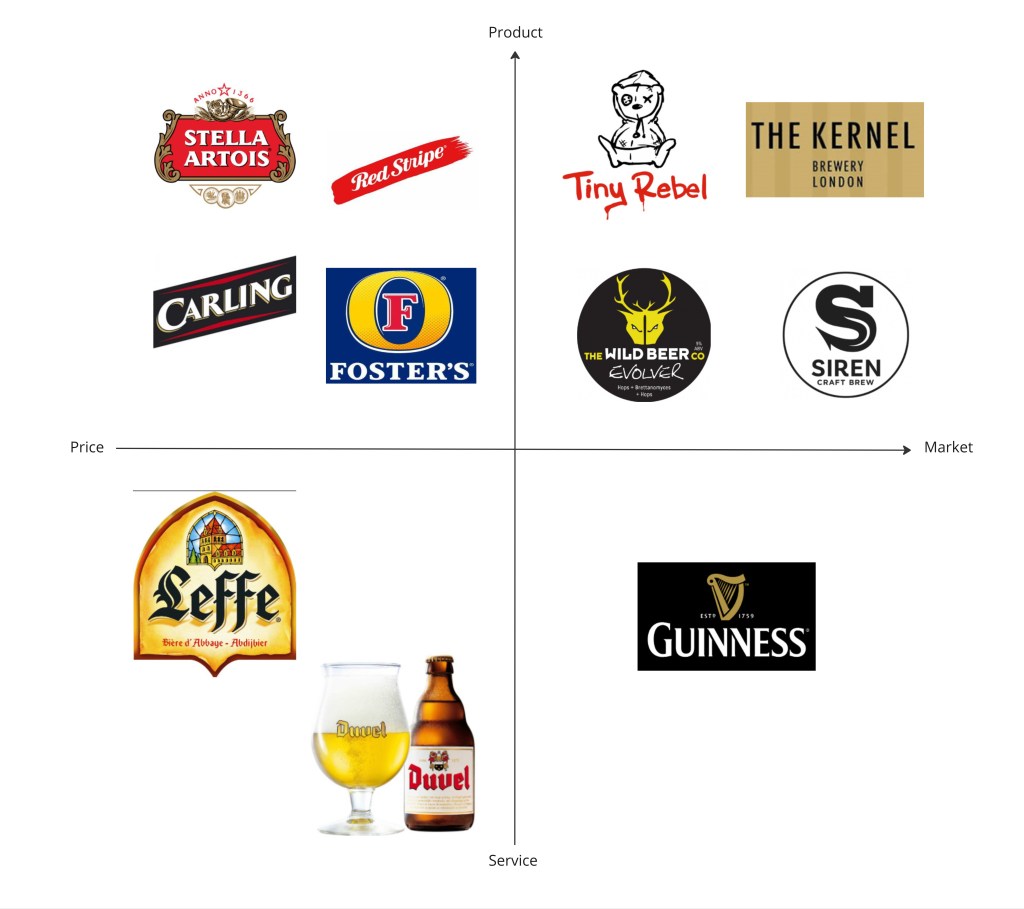
Price-Product: These are either the very cheap beers or those that are sold at a premium price. For this exercise, we have chosen cheap and simple high-street lagers.
Product-Market: Craft beers have been chosen for this section as they appeal to a specific demographic. While they can be enjoyed by all, they are for the ‘beer’ adventurer who is looking for something different to the mainstream.
Market-Service: Guinness is a great example of this. What other ‘beer’ do you have to wait for and be poured a specific way? Guinness is the most sold stout in the world, with 1 in 10 draught beers in the UK being Guinness. The company has worked hard to place engineers in pubs to enable them to set up for the perfect pour and has worked tirelessly on reducing the time taken from source to glass, to improve taste.
Service-Price: The best example I could think of here was Belgium beers. These beers are expensive, often high in alcohol, and typically come with their own uniquely shaped or branded glass. Furthermore, to get a large selection you are most likely travelling to a specialised vendor.
How about you and your business? Where are you positioned? If you would like any further clarity, please do not hesitate to get in contact me using chris.robertson@sgfe.co.uk.
 Free-ness